
Recruiting cabin crew involves more than finding candidates with good communication skills and a customer-facing personality. Airlines need people who can respond to challenging situations, work under pressure, collaborate with colleagues and understand the responsibilities that come with passenger safety.
When hundreds or thousands of people apply for a limited number of positions, evaluating these qualities becomes a considerable recruitment challenge.For Pakistan International Airlines (PIA), Cabin Crew Hiring 2026 presented an opportunity to introduce a more technology-driven approach to candidate screening and assessment.
Through its partnership with The Talent Games, PIA brought C-Factor AI into two important stages of its recruitment process, using Aly for initial candidate screening and Kai to support recruiters during assessment-centre activities.
The project offers a practical example of how AI can support aviation recruitment without taking the human element out of hiring.
Why Is Screening Cabin Crew Candidates Different?
Type your paragraph here
Cabin crew members represent an airline throughout the passenger journey. Their responsibilities extend beyond delivering customer service. They must also respond to unexpected situations, communicate effectively and work as part of a coordinated team.
The International Civil Aviation Organization (ICAO) recognises the importance of competency-based training and assessment for cabin crew. Its Cabin Crew Safety Training Manual provides guidance on evaluating the competencies required to perform cabin crew duties.This makes recruitment particularly demanding.
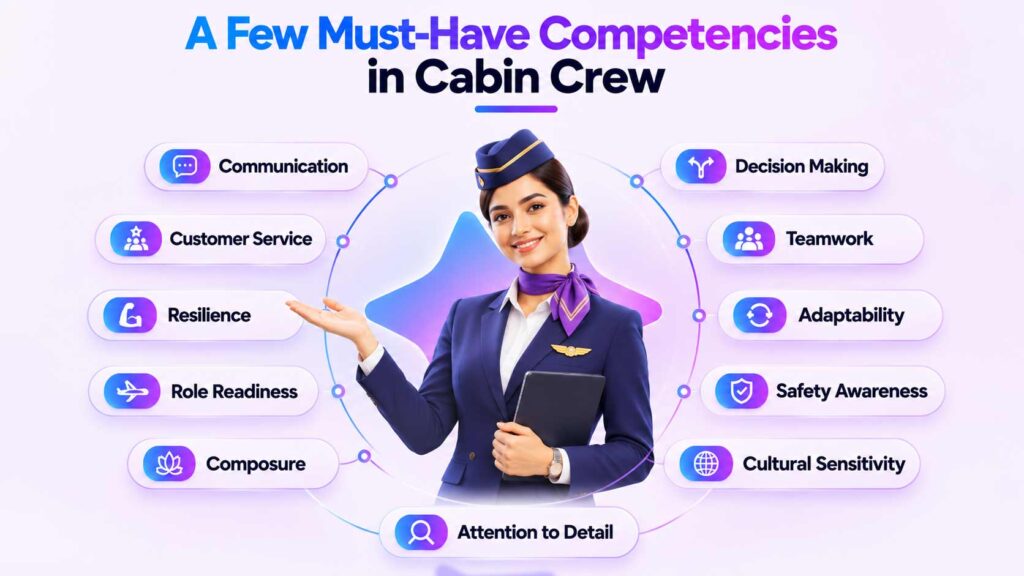
Airlines need to assess several qualities together, rather than relying on a candidate’s CV or first impression.Some relevant areas of evaluation include:
Communication:
Expressing information clearly and interacting effectively with passengers and colleagues.
Customer service:
Understanding passenger needs and responding professionally.
Situational judgement:
Making appropriate decisions when circumstances change.
Problem-solving:
Responding to unexpected challenges.
Teamwork and adaptability:
Working effectively with others in different situations.
Emotional intelligence:
Managing interactions with empathy and professionalism.
These competencies require more than a conventional screening call. Recruiters need a process that can identify relevant experience early and create opportunities to explore how candidates respond to realistic situations.
How PIA Introduced AI into Its Cabin Crew Recruitment Process
PIA wanted to introduce AI into its Cabin Crew Hiring 2026 programme while improving transparency, supporting competency-based evaluation and bringing greater consistency to different recruitment stages.The Talent Games partnered with PIA to implement C-Factor AI, deploying two specialised agents with distinct responsibilities.
1. Aly: AI-Powered Initial Candidate Screening
The first challenge was managing the initial screening stage.
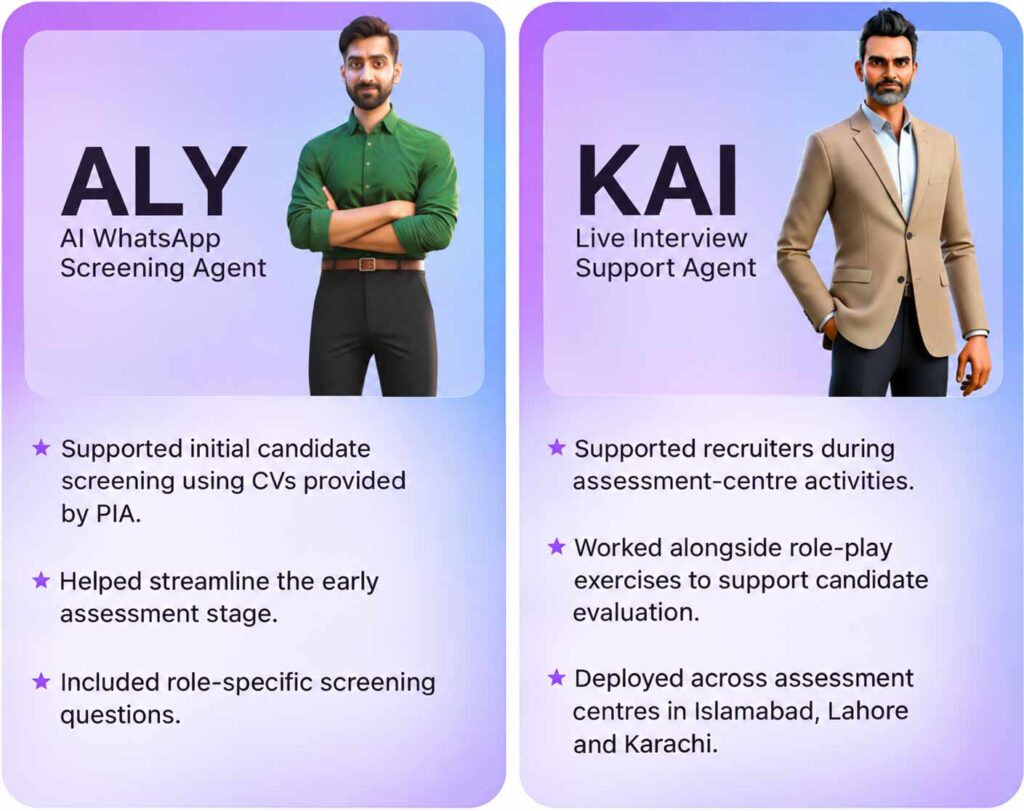
PIA provided candidate CVs, and Aly supported the initial screening process against the requirements established for the recruitment programme.
Rather than treating AI as a replacement for recruiters, Aly introduced an additional layer of support at the beginning of candidate evaluation.
This is particularly relevant to large-scale aviation recruitment, where recruiters need to review substantial applicant pools before candidates progress to more involved assessment stages.C-Factor AI’s Aly AI Screening Agent is designed to conduct conversational candidate screening through text and voice interactions. It can check role-specific requirements, ask relevant follow-up questions and provide structured qualification insights.
For recruitment teams, this creates an opportunity to spend less time on repetitive initial screening and more time reviewing candidates who progress through the selection process.
2. Kai: Supporting Recruiters at Assessment Centres
Initial screening is only one part of cabin crew selection. Candidates also need opportunities to demonstrate their capabilities in practical situations.
For PIA, the next stage involved assessment-centre activities and role-play exercises.
This is where Kai, C-Factor AI’s Real-Time Interview Support Agent, supported recruiters.
Kai assisted the recruitment team during assessment-centre activities, working alongside role-play exercises to support candidate evaluation.
The assessment centres took place across three cities:
Islamabad
Lahore
Karachi
Through Kai’s real-time interview support capabilities, recruiters can receive relevant questions, follow-up suggestions and competency-based evaluation support during live interviews.
The important distinction is that the recruiter remains in control of the interaction. AI provides additional guidance and documentation support, while human assessors remain involved in evaluating candidates and making selection decisions.
PIA Cabin Crew Hiring 2026: Project Results
The recruitment programme recorded substantial candidate participation across its pre-assessment and subsequent assessment-centre stages.
Here is a snapshot of the project:
Candidates invited to pre-assessment | 1,234 |
Pre-assessments completed | 1,001 |
Completion rate | 81.1% |
Candidates recorded at Role Play + Kai stage | 206 |
Assessment-centre locations | 3 |
The 81.1% pre-assessment completion rate demonstrates the level of participation across the programme. Meanwhile, 206 candidates were recorded at the combined Role Play and Kai stage.
These figures illustrate how AI-assisted screening and assessment support were incorporated into a recruitment programme operating across multiple locations.
More importantly, Aly and Kai supported different stages of the same candidate journey rather than functioning as disconnected technology solutions.
What Does This Mean for the Future of Aviation Recruitment?
The aviation industry has specific recruitment requirements that cannot be addressed through application screening alone.
The International Air Transport Association (IATA) highlights how cabin safety involves risk management, training, reporting, human performance and operational procedures.
This reinforces an important point for HR teams: cabin crew recruitment needs to consider the capabilities that candidates will eventually need to demonstrate in real working environments.
AI can support this process in several ways:
- Handling large applicant pools:
Introducing structured screening before candidates reach more resource-intensive assessment stages. - Supporting competency-based evaluation:
Helping recruiters focus on qualities relevant to the responsibilities of the role. - Assisting multi-location recruitment:
Providing additional assessment support across different recruitment centres. - Improving documentation:
Helping teams maintain more structured records of candidate evaluation. - Keeping human judgement involved:
Giving recruiters additional information without transferring final hiring decisions to AI.
However, these benefits depend on how the technology is implemented. AI-generated assessments need clear criteria, appropriate oversight and relevance to the actual role.
A Perspective from PIA's Leadership
The collaboration brought together AI-assisted candidate screening and assessment-centre support as part of PIA’s Cabin Crew Hiring 2026 programme. Junaid Asrar Khan, Head of HR Digital Transformation & TA at Fatima Group, shared his perspective on the experience:
“It’s been a meaningful experience to bring our vision for PIA’s Cabin Crew Hiring 2026 to life. Working with The Talent Games, we used Aly for initial candidate screening and Kai to support our team at the assessment centre. Seeing technology come together with real-time aviation scenarios has been particularly rewarding. I look forward to seeing how we continue to build a new chapter for PIA.”
He also recognised the opportunity to strengthen the candidate experience and employer brand through a more technology-driven approach.
A Note from Paul Keijzer, CEO of The Talent Games and Founder of C-Factor AI
Paul Keijzer believes that introducing AI into recruitment should never mean losing sight of the people involved in hiring decisions.
“Recruitment in aviation comes with its own demands, and technology must be able to support those requirements without losing sight of the people behind every hiring decision.”
The PIA collaboration reflects this approach by using AI to support different recruitment stages while keeping recruiters and assessors involved throughout the process.
The Next Chapter of Aviation Hiring Will Be Built on Better Assessment
The future of aviation recruitment will not be defined simply by how quickly airlines can process applications. It will depend on how effectively they identify people who can handle the responsibilities of working in aviation.
As airlines continue to adopt new recruitment technologies, the opportunity lies in connecting early candidate screening with practical, competency-based evaluation.
A candidate’s CV may tell an airline where they have worked. An interview can reveal how they communicate. A role-play exercise can offer a closer look at how they respond to a situation.
Bringing these stages together creates a more informative picture of the person behind the application.
PIA’s Cabin Crew Hiring 2026 programme demonstrates one way this can work in practice. With Aly supporting initial screening and Kai assisting recruiters during assessment-centre activities, C-Factor AI helped introduce AI-assisted evaluation into a large-scale, multi-location aviation recruitment process.
For airlines planning their next recruitment drive, the bigger question is no longer simply whether to introduce AI. It is where AI can provide meaningful support, which competencies need to be assessed and how human expertise can remain central to every hiring decision.
That is where the next chapter of aviation hiring begins.
Explore C-Factor AI to discover how AI-powered screening and assessment can support your recruitment process.