

Every hiring decision C-Factor AI touches is built to be clear, explainable, and easy to stand behind. This isn’t a compliance page, it’s how we’ve built the whole platform, from the assessment builder to the interviewing agents to the reports your leadership team acts on.
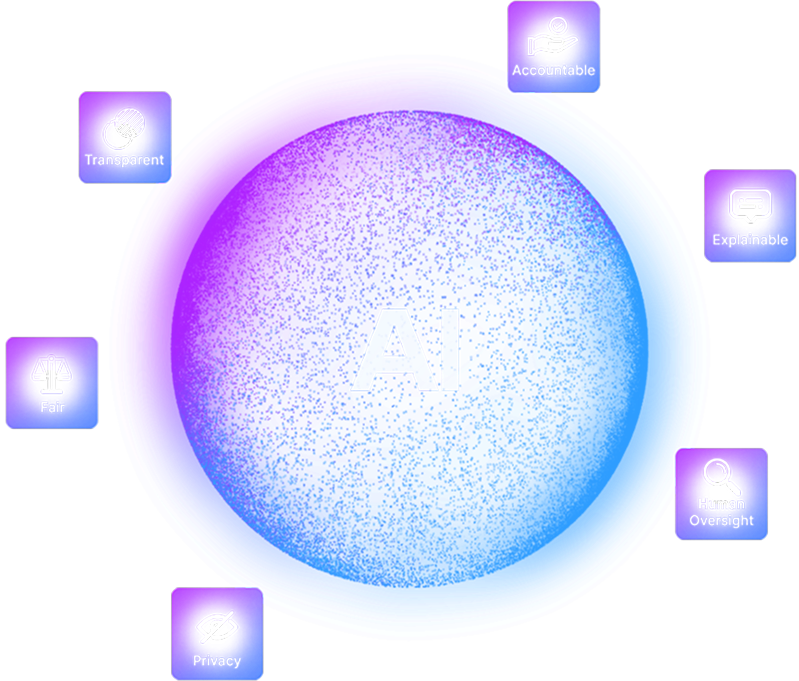
Every candidate is told at the start that they're speaking with AI, that a human reviews their score.
Every score links back to the specific moment, answer, or signal that produced it.
C-Factor AI never makes a hiring decision on its own. It produces structured, scored recommendations. Your team makes every hire, every reject, every callback.
Structured scoring rubrics and the same core questions for every candidate reduce the chance of bias creeping in through unrelated signals like accent, background, or appearance.
Candidates can request deletion of their data, ask how they were assessed, and know where their data is stored. Encrypted at rest and in transit. Data residency options across EU, UK, UAE, Singapore, and US.
Principles are easy. Where responsible AI actually happens or doesn’t is in the design of specific product surfaces. Here’s how each layer of C-Factor AI is engineered for trust.
Where assessment questions, criteria, and competencies are defined to support structured candidate evaluation.
We build competencies from the job description and established role frameworks, not from proxy signals like personality traits, hobbies, or lifestyle data.
We structure assessment experiences around the skills, competencies, and requirements relevant to the role, helping keep candidate evaluation focused and consistent.
We draw on established assessment principles to help structure questions, competencies, and evaluation criteria around the requirements of each role.
We continue to improve our assessment tools and experiences as the platform evolves and we learn more from practical use and feedback.
Every candidate is told at the start: they’re speaking with AI, their responses will be scored with human review, and they can request a human interviewer instead. Candidates who prefer a human get one full stop.
Every candidate for a role receives the same core questions, the same time limits, and the same scoring rubric. Adaptive follow-ups probe deeper on the same competencies never on unrelated proxies like accent, background, or appearance.
30+ languages, native accent, screen-reader compatibility, and choice of format (text, voice, or video) mean the interview meets the candidate not the other way around. No candidate is disadvantaged because they don’t speak, look, or type like the default user.
Candidates can pause at any point, withdraw from the interview without penalty, or escalate to a human recruiter. Their data is deleted on request. None of this affects their standing in the process that’s a hard rule.
C-Factor AI produces scored recommendations. It never issues rejections without human review. Every candidate flagged as not-qualified gets a human recruiter’s second look always.
AI-generated assessment information should be considered within the broader hiring context. We encourage hiring teams to use AI as supporting information alongside their own professional judgment.
we aim to present AI-generated assessment information in a structured and understandable way, helping hiring teams see the information available to them when evaluating candidates.
We aim to make the assessment experience clear and straightforward for candidates, with appropriate information about how AI-enabled tools are used during the process.
CEO · The Talent Games


AI is becoming an important part of how we approach hiring technology, but thoughtful use has to remain at the center. We believe AI should support hiring teams with useful, structured information while keeping human judgment involved. That means being clear about how AI is used, recognizing its limitations, and considering the people affected by hiring decisions. For us, reliable AI means building practical technology that hiring teams can use responsibly and with clarity.
We handle candidate data the way we’d want our own handled — encrypted, access-controlled, and never sold or shared beyond what’s needed to run your hiring process.

Our public commitment to fair AI use. Signed by leadership.

ISO 27001 for information security management system.

EU data protection. Right to deletion, portability, and objection. Data residency across EU, UK, UAE, Singapore, and US.

Enterprise cloud infrastructure with regional data isolation and end-to-end encryption.
Every candidate for a role gets the same core questions and the same scoring criteria. Structured rubrics are designed to score job-relevant answers, not proxy signals like accent or background.
Always. Every C-Factor AI agent like Noor, Aly, Riya, Kai, Maya, they introduce themselves as AI at the start and explain that a human reviews the scoring.
No. C-Factor AI produces scored recommendations. Every hire, reject, or next-round callback is a human decision, including for candidates who clearly miss must-have requirements.
Data is encrypted at rest and in transit. Retention periods are configurable by the customer, typically 90 days to 2 years depending on regional requirements. Candidates can request full deletion at any time. Data residency options: EU, UK, UAE, Singapore, US.
Yes. Candidates can request their score explanation and appeal a decision they believe was unfair.
AI used in hiring is treated as high-risk under the EU AI Act. We’ve reviewed our platform against the Act’s requirements, technical documentation, human oversight, data governance, and transparency, and continue to build toward full alignment.